
Landing at Paris-Charles de Gaulle with a group of five to nine people, bags in hand and a week ahead of you, raises one immediate question: how do you all travel together without splitting into multiple vehicles or juggling complicated train connections? A single minibus solves this puzzle. Rather than coordinating several hire cars or relying on taxis and public transport, a 7- to 9-seat minibus keeps your group under one roof from the moment you collect your luggage to the moment you return the keys seven days later.
This article walks you through five realistic one-week itineraries departing from Paris-CDG, explains what you need to drive a minibus in France, and highlights the contract details that deserve your attention before you sign. Each itinerary is built around the same practical grid—total distance, daily driving estimates and suitable group profile—so you can compare options and choose the route that matches your interests and stamina. Whether you are drawn to the D-Day landing beaches of Normandy, the châteaux of the Loire Valley or the vineyards of Burgundy, the goal remains the same: a week on the road that feels manageable, memorable and genuinely achievable.
Why hire a minibus at Paris-CDG for a one-week road trip?
Arriving at Roissy Charles-de-Gaulle with a group generates immediate logistical questions. Hiring two or three smaller cars means coordinating multiple drivers, splitting the group at rest stops and paying separate rental fees, insurance deposits and fuel bills. A minibus consolidates everything: one vehicle, one contract, one set of keys and enough boot space for everyone’s luggage without playing Tetris with suitcases.
Standard 7- to 9-seat minibuses fall within catégorie M1 du Code de la route, the French regulatory category for passenger vehicles with a maximum of eight seats besides the driver and a gross vehicle weight not exceeding 3.5 tonnes. This classification matters because it determines which driving licence you need. A category B licence—the standard driving licence issued in France and across the European Union—covers vehicles in this category, provided the total laden weight stays within the 3.5-tonne limit. Service-Public.fr confirms that a B licence permits you to drive a car, a van and, under specific conditions, a motorhome or certain two-wheelers, without requiring any additional endorsement for a typical 9-seat minibus.
Driving licence requirement: A standard category B licence is sufficient to drive a 9-seat minibus in France, as long as the vehicle’s gross weight does not exceed 3.5 tonnes—a threshold respected by most rental minibuses.
Budget considerations also favour a single minibus. While exact hire costs vary by season, booking lead time and rental company, sharing one vehicle’s daily rate, fuel and tolls across seven or eight people generally proves more economical than splitting into two saloon cars and duplicating every expense. Convivialité plays a role too: travelling together means shared playlists, spontaneous route changes and the ability to stop for a picnic without sending a group text to coordinate three separate cars.
If you prefer to collect your vehicle directly at the airport, WeVan operates a minibus hire branch in Paris-Nord at Roissy CDG, offering delivery to the airport so you can drive away shortly after clearing arrivals. The company reports a customer rating of 4.8 out of 5 and currently promotes the code MINIGO26 for a discount on qualifying bookings, though you should verify the precise conditions and expiry date before reserving.
5 unforgettable one-week itineraries from Paris-CDG
Choosing an itinerary depends on your group’s interests, tolerance for daily driving and appetite for variety versus depth. The following five routes are designed to fit a seven-day return trip from Paris-CDG, with distances and stages calibrated to avoid turning the journey into an endurance test. Each itinerary assumes you collect the minibus on day one and return it on day seven, leaving approximately five full days for exploration.
Five routes at a glance
- Normandy & D-Day: history, coast, cider country; roughly 250–280 km each way.
- Loire Valley: châteaux, riverside towns, gentle cycling; approximately 200–240 km each way.
- Champagne & Alsace: vineyards, half-timbered villages, eastern France; around 400–450 km one way.
- Brittany: rugged coastline, crêperies, Celtic culture; about 350–400 km each way.
- Burgundy & Jura: wine estates, mountain cheese, lakeside scenery; roughly 300–350 km each way.
Normandy and the D-Day landing beaches
Leave CDG westbound on the A13 motorway, reaching the Normandy coast in under three hours. Base yourself in Bayeux or Arromanches for two or three nights, allowing time to visit the American Cemetery at Colleville-sur-Mer, Pointe du Hoc and the museums at Utah and Omaha beaches. Drive east along the coast to Honfleur’s old harbour, then loop back via the Pays d’Auge cider route. Total driving over the week sits around 500 to 600 kilometres, comfortably manageable with stops for Mont Saint-Michel if you add a night near the bay.
Loire Valley châteaux circuit
Head south from Paris on the A10, exiting near Orléans or Blois. Spread three or four nights between towns such as Amboise, Chenonceau and Saumur, giving you time to tour Chambord, Villandry’s gardens and the troglodyte dwellings at Rochemenier. Daily drives between châteaux rarely exceed 50 to 70 kilometres, leaving afternoons free for riverside picnics or wine tastings in Vouvray. Round-trip mileage typically falls between 400 and 500 kilometres, one of the lighter itineraries in terms of wheel time.
Champagne vineyards and Alsace villages
This route stretches further east. Drive to Reims on the A4, spend a day exploring Champagne cellars, then continue via the Vosges mountains to Strasbourg and Colmar. Allocate two nights in Alsace to wander half-timbered villages such as Riquewihr and Eguisheim, then return to Paris via Nancy or Metz. One-way distance hovers around 450 kilometres, so expect roughly 900 to 1,000 kilometres total, with longer driving days balancing shorter sightseeing hops once you reach Alsace.
Brittany’s Atlantic coastline
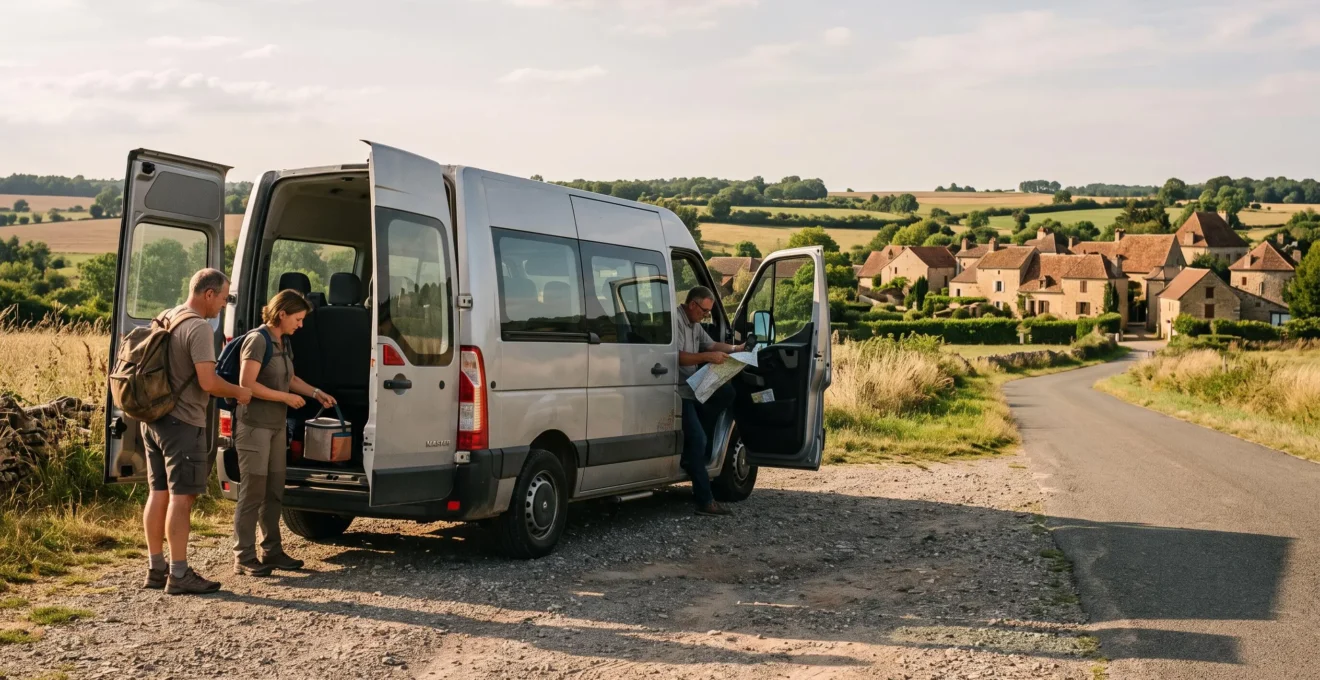
Take the A11 motorway west through Le Mans to Rennes, then branch north-west to Saint-Malo or south to Quiberon and the Gulf of Morbihan. Brittany’s granite headlands, fishing ports and crêperies reward a leisurely pace; two or three coastal bases let you explore beaches, lighthouses and medieval towns without daily packing. Expect around 700 to 800 kilometres round-trip, with the option to cut north via Mont Saint-Michel on the return leg if you skipped it on the Normandy route.
Burgundy vineyards and the Jura lakes
Drive south-east on the A6 to Beaune, the heart of Burgundy’s wine trade. Spend two nights touring cellars and tasting Pinot Noir, then continue east into the Jura via Arbois and the Baume-les-Messieurs cirque. The lakes around Clairvaux and Chalain offer swimming and walking; Comté cheese co-operatives provide edible souvenirs. Total distance runs to approximately 600 to 700 kilometres, balanced between motorway cruising and winding Jura valleys.
| Itinerary | Approx. round-trip distance (km) | Main appeal | Ideal group profile |
|---|---|---|---|
| Normandy & D-Day | 500–600 | History, coast, cider | War-history enthusiasts, families |
| Loire Valley | 400–500 | Châteaux, gardens, wine | Culture lovers, relaxed pace |
| Champagne & Alsace | 900–1,000 | Vineyards, villages, mountains | Longer drives, wine fans |
| Brittany | 700–800 | Coastline, seafood, Celtic culture | Beach seekers, walkers |
| Burgundy & Jura | 600–700 | Gastronomy, lakes, cheese | Foodies, outdoor enthusiasts |
How to plan your route, driving times and toll roads
A loaded minibus with seven or eight passengers and their luggage handles differently from an empty saloon car. Acceleration is slower, braking distances lengthen and motorway speeds feel less effortless. Planning daily driving stages of 150 to 250 kilometres keeps fatigue manageable and leaves room for unplanned detours, longer lunches and the inevitable twenty-minute search for parking in a medieval town centre.
France’s motorway network—autoroutes à péage—is extensive, fast and tolled. Most rental minibuses accept payment cards at automated barriers, though carrying some cash provides a fallback if the machine declines your card. Toll costs depend on distance and vehicle category; a minibus under 3.5 tonnes pays the same rate as a standard car. Budget indicatively between €40 and €80 for a return trip to Normandy or Burgundy, rising to €100 or more for the longer Champagne-Alsace loop. Official tariffs are published by motorway operators, and online toll calculators offer route-specific estimates.
Toll-road tip: Keep a payment card handy in the driver’s door pocket; automated barriers accept contactless and chip-and-PIN cards, but occasional system glitches make a second card or cash a sensible backup.
Driving in rotation spreads the workload, though only licence holders meeting the rental company’s age and experience requirements may legally take the wheel. Schedule breaks every ninety minutes to two hours, using motorway aires for fuel, coffee and restrooms. Many aires offer picnic tables and walking loops; the larger ones include playgrounds and regional-produce kiosks, turning a comfort stop into a minor attraction.
Before signing: what should you check in your rental contract?
A rental contract contains clauses that matter more than the headline daily rate. Four areas deserve careful reading before you sign: the deposit or authorisation hold, insurance coverage and excess, mileage limits and fuel policy.
The deposit—often labelled as a pre-authorisation—blocks a sum on your credit card as security against damage, fines or fuel shortages. Amounts vary widely, from €500 to €2,000 or more, depending on the vehicle and the rental company’s risk appetite. This hold is released days or weeks after you return the minibus, provided no claims arise. Budget hire companies sometimes impose higher deposits to offset cheaper daily rates; premium operators may waive the deposit if you purchase additional insurance at booking.
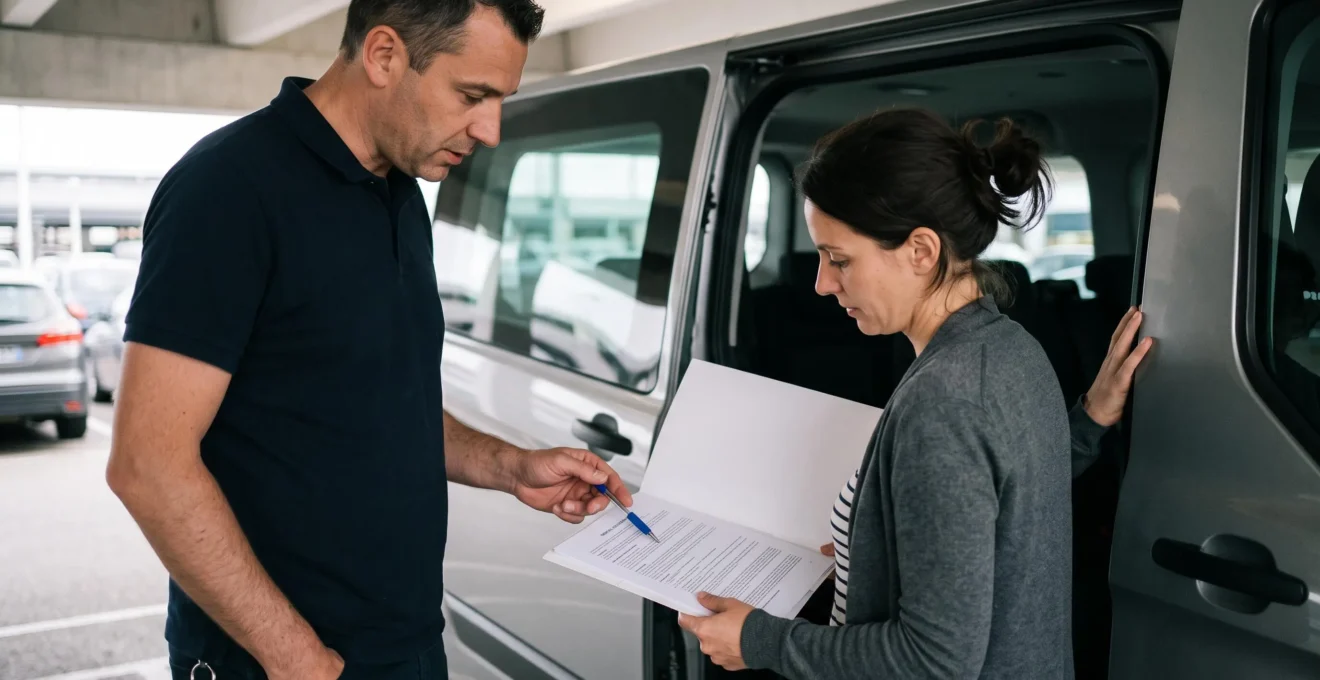
Insurance and excess define your financial exposure if the minibus is damaged. Basic cover typically includes collision damage waiver and theft protection, but an excess—the amount you pay before insurance activates—can reach €1,500 or higher. Purchasing excess-reduction insurance at the counter or through a third-party broker lowers this risk, though at an additional daily cost. Read the list of exclusions: tyres, windscreens, undercarriage damage and off-road driving often fall outside standard policies.
Mileage limits distinguish between contracts offering unlimited kilometres and those capping daily or weekly totals, often at 200 to 250 kilometres per day. Exceeding the cap triggers per-kilometre charges that mount quickly on a 1,000-kilometre itinerary. For a week-long road trip across multiple regions, unlimited mileage removes the need to track your odometer and provides freedom to extend detours without worrying about penalty fees.
Fuel policy varies. Full-to-full arrangements require you to return the minibus with a full tank, matching the level at pickup; failing to refuel incurs refuelling charges plus a service fee. Pre-purchase fuel plans let you pay upfront for a full tank and return the vehicle empty, but these rarely offer good value unless you time your arrival at the depot with the needle on empty. Confirm the fuel type—most minibuses run on diesel (gazole) rather than petrol (essence)—and note the location of the nearest filling station to the return point.
Read before you reach the counter: Reviewing the contract at home, before your flight, allows you to compare terms across rental companies and query unclear clauses by email, rather than deciphering legal text in a busy airport car park after a long journey.
For a detailed breakdown of common contract clauses and how to interpret them, consult a rental-contract guide that explains excess structures, additional-driver fees and cross-border restrictions in plain language.
Ready to hit the road? Booking your minibus step by step
Booking a minibus for a one-week group trip follows a straightforward sequence. Start by comparing hire companies that operate at or near Paris-CDG, filtering by vehicle size, mileage policy and customer reviews. Enter your arrival and departure dates, ensuring the pickup time aligns with your flight’s scheduled landing plus realistic allowance for baggage claim and customs. Most rental desks close by late evening; if your flight lands after hours, confirm whether out-of-hours collection is possible and what additional fees apply.
Select a 7- to 9-seat minibus from the available fleet, checking specifications for boot capacity—measured in litres or described by the number of large suitcases the vehicle can swallow with all seats occupied. Read the included and optional extras: GPS navigation, additional drivers, child seats, winter tyres and roadside-assistance packages each carry separate charges. Add only what you genuinely need; your smartphone often provides navigation as effectively as a built-in unit, provided you download offline maps before departure.
- Compare and select
Filter by vehicle capacity, mileage terms and airport delivery; note deposit and excess amounts.
- Review the contract
Check fuel policy, insurance exclusions, cross-border permissions and cancellation terms before confirming.
- Book and pay
Provide the main driver’s details and payment card; some companies charge immediately, others pre-authorise only.
- Receive confirmation
Print or save the voucher, including emergency contact numbers and the exact pickup location at CDG.
- Collect on arrival
Present your driving licence, passport, credit card and voucher; inspect the minibus for existing damage and photograph any marks before driving away.
WeVan, for instance, communicates a current promotion offering €40 off bookings over €800 with the code MINIGO26, subject to availability and validity dates you should verify directly on their website. The company’s 4.8 out of 5 rating reflects customer feedback on fleet condition, service speed and transparency, though individual experiences vary.
Once the booking is confirmed, create a simple day-by-day route plan using one of the itineraries outlined earlier or a hybrid tailored to your group’s interests. Share the draft with your passengers, assign driving shifts if multiple licence holders are travelling, and confirm accommodation bookings in advance—especially during French school holidays when Loire châteaux hotels and Brittany coastal gîtes fill quickly. Carry the rental agreement, your driving licence, passport and payment card in a dedicated travel wallet; French police may request these documents at roadside checks, and rental depots require all of them for vehicle release.
A week on French roads with your entire group under one roof transforms the logistics of arrival at Paris-CDG into the starting line of a shared adventure. Whether you return from Normandy’s windswept cliffs, Burgundy’s vineyard slopes or Brittany’s oyster beds, the minibus waiting at the airport car park on day one makes that journey possible without splitting up, without stress and without compromise.
For additional guidance on preparing for pickup day, managing insurance options and understanding your responsibilities as the hirer, explore the practical van-rental process to ensure every detail is covered before you collect the keys.